
The Biblically Ethical Use Of AI

This is a beautiful treatment of this topic by Ad Lib coach Craig Knapp.
Something I hear constantly in conversations, especially in the tech realm, is the fear that AI is replacing human jobs. Frequently, I get asked the question, “Aren’t you afraid that (fill in the blank) job will be replaced by AI?”
The underlying concern isn’t just, “Will AI take my job?” The deeper question underneath it is, “Will my work still matter?” And if I’m honest, that question usually keeps sliding one step closer to the heart: “Do I still matter?”
Because work isn’t only how we earn money to pay the bills. For many of us, work is woven into identity. It’s one of the primary places we live out our calling, steward our gifts, and grow in maturity. It’s where we build competence over time, develop character under pressure, and learn how to serve real people—not in theory, but in the everyday.
So when something enters our world that can imitate what we produce—especially the creative things we’ve poured ourselves into—it doesn’t just challenge our output. It presses on dignity. It pokes at purpose. It raises questions about whether our contribution is still meaningful, and whether our presence is still needed. And that’s why this conversation matters: not because AI technology is bad, but because your value is deeper than the work you do—and your work, at its best, has always been an expression of that value, not the source of it.
From a biblical perspective, those concerns are legitimate. We have been created to be image-bearers of our Heavenly Father, the Creator of the universe. That means our work, our job, our craft, our calling is not random. Our work is one of the primary places we live out what God made us to do and to be. And, contrary to how modern workplaces can talk about people, we are not merely replaceable units of production (Genesis 1:26–28). Three things we can learn from that.
We are made in God’s image.
There is no metric that can measure its worth.
We have a real calling on our lives from God.
That’s why the thought of being replaced by AI doesn’t just raise practical concerns; it triggers spiritual anxiety. It can make a faithful person question, “Did I misunderstand my calling? If my job is this vulnerable, did I miss what God intended for me? Shouldn’t something God gave me be irreplaceable?” Those are honest questions, and they deserve a biblical answer.
Here is the answer, and it is good news: From the beginning of time, God has had a plan for you, and AI cannot replace that calling on your life. Your calling is not as fragile as a job title. It’s not propped up by a role, a platform, or a paycheck. God’s assignments for you are anchored in who He made you to be, not just what you produce.
We are His children, created in the image of God. We have a soul. We have a spirit. We can hear God, respond to Him, and follow Him with faith and obedience. AI, by contrast, is created by humans. It has no soul. It lacks the human spirit and cannot receive divine inspiration (Job 32:8). Although AI can process patterns, it cannot carry presence. It can generate the output, but it cannot offer worship to God. It can imitate form, but it cannot fulfill your calling.
And because of that, AI is best understood as a tool; though powerful, it is still a tool. Like any tool we use, it is morally neutral in itself; the moral weight rests on the person using it. The question isn’t whether AI should be used. The real question is whether we will use it with wisdom, integrity, and clarity about what can never be outsourced: the human calling to reflect God, serve people, and steward our gifts with faithfulness.
Scripture gives us a stable center here: God creates, and, as a derivative gift of being made in God’s image, humans create. Our creativity is not merely a market advantage; it’s an outlet, though we are imperfect, we are a real reflection of our Creator. That means our creativity deserves honor, protection, and truthful attribution, not exploitation. AI is not creative; AI doesn’t generate original material; AI only compiles, classifies, and reorders existing data that it has been fed by humans.
Worship is not generated—it’s given
Music created for worship is meant to be an embodied act of the gathered church, not a detached product delivered to an audience. Paul’s picture of worship is communal and participatory: “Let the word of Christ dwell in you richly, teaching and admonishing one another in all wisdom, singing psalms and hymns and spiritual songs” (Colossians 3:16). That’s not a sterile transaction. It is a living moment where real people, in a real room, turn their attention together toward our Heavenly Father, who is infinitely worthy of all our worship. Worship isn’t just generated media. It is our hearts, our voices, our bodies, in faith responding to God in real time.
And that’s exactly why AI cannot replace us. AI cannot create worship; it cannot experience the presence of God, which is part of our worship. It cannot love God. It cannot repent, rejoice, or surrender. At most, it can mimic the shape of worship language, but it cannot offer worship to our God as we do from our hearts, because it doesn’t have one. Worship isn’t merely correct words placed over the right chords; it is our human response to God.
This is where the ethical weight starts to show. Reliance on AI in creative spaces can quietly dehumanize art. It can dilute the real connection between the artist and the listener, and, even more importantly, between the worshiper and God. In congregational worship, God is not primarily honored by technical prowess, but by the heart and the intent behind what is offered. Paul ties our singing to spiritual formation. “Be filled with the Spirit, addressing one another in psalms and hymns and spiritual songs, singing and making melody to the Lord with all your heart,” (Ephesians 5:18-19). Our worship should be a sacrifice, as “King David said to Araunah, “No, but I will buy it from you for a price. I will not offer burnt offerings to the Lord my God that cost me nothing.” (2 Samuel 24:24a)” The Psalms push the same direction: worship that is personal, wholehearted, and skillful is an offering; there is no shortcut. “Sing to him a new song; play skillfully” (Psalm 33:3) calls us to intentionality and sacrifice. AI can help us on that journey it should not be used to replace our calling in that regard.
Paul gives us a strong boundary line here: “All things are lawful,” he says, “but not all things are helpful… I will not be dominated by anything” (1 Corinthians 6:12). In other words, the question isn’t only, “Can I?” The question is, “Is using AI to do this helpful? Or, is it creating a dependence that is enslaving me?”
Should we use AI in our ministry calling? Yes—when it makes sense. If a tool can strengthen clarity, lighten recurring daily tasks, or reduce unnecessary friction for your team, that can be wise stewardship. But we don’t use tools in ways that replace our true calling. We use them to support the work God has given us, not to substitute for the part only people can carry.
So here’s the question I want to leave with you as you think about AI in your church worship and tech ministry: Is this forming us, or are we outsourcing the very skills we’re called to steward?
And that’s the line to keep clear: don’t confuse output with offering. In worship, the “why” and the “who” matter as much as the “what,” because worship isn’t generated—it’s given.
-Dave Helmuth
Author of the Five Faders and Founder of Ad Lib Music
The Biblically Ethical Use Of AI (Nº 464)
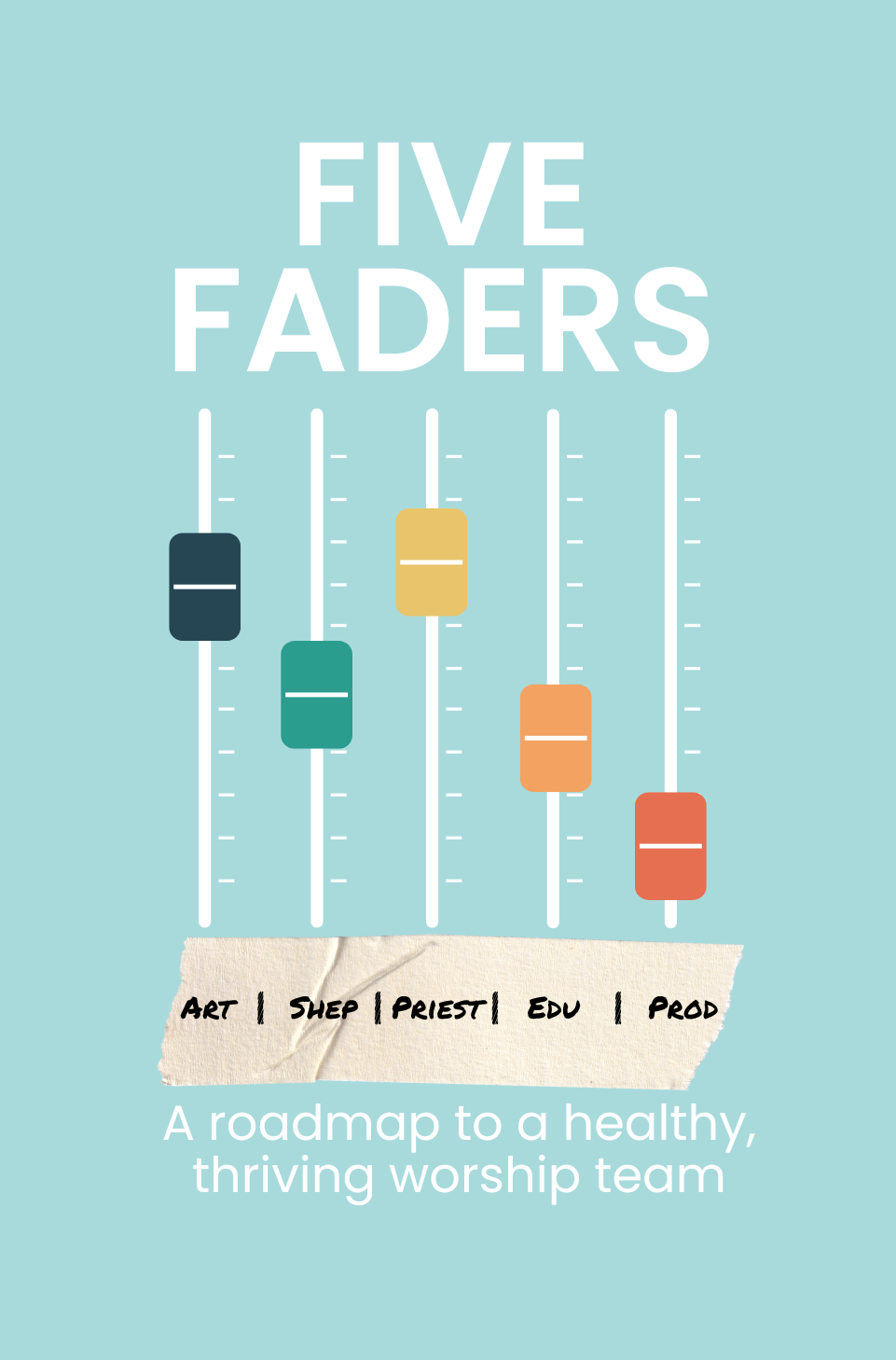

Five Faders w/ Dave Helmuth
Don't be another passionate, unhealthy leader (who doesn't know they are unhealthy) who misses their calling, has a moral failure, burns out, or burns others. (dang, that's dark!)
Be a Five Faders leader who is the best version of yourself and helps your team to do the same!
We'll explore the motivations we each have:
Artists notice nuance.
Shepherds consider the individual.
Priests overflow with simple love and pure devotion to Jesus.
Educators bring out the best in others.
Producers plan, in order to exceed usual limits.
The Five Faders model is not just a tool, it's a game-changer. It will help you understand your motivations and those of your team, paving the way for healthier and more effective leadership. The good news is that a Five Faders team is fantastic! The bad news is that if we don't know what motivates us, our passion often blinds us and we are an unhealthy expression of our Fader.
In this small group, we'll not just learn about the Five Faders, but also put them into action. We'll explore how to apply the concepts to our teams in a practical way, and learn from each other, which is one of the best ways to grow in your lowest Fader.
DATES AND TIMES
Mondays from 9 to 10:30 AM Central, from January 6 to February 24 (8 weeks)
BUY THE BOOK
https://amzn.to/4mWlA6a
WHO IS DAVE HELMUTH
I'm a coach who leads Ad Lib Music, the worship coaching organization I started in 2002. We have coaches in Pennsylvania, Colorado, Texas, and South Dakota. I'm the author of the Five Faders book. I serve as a missionary in Costa Rica, where my family of nine and I have lived since 2019.