
Make More Excellent Music

We want to make excellent music. And by “excellent,” I mean the best we can do with what we have. It’s a continuously moving target. It’s personal - you don’t become excellent by comparing yourself to others but by comparing yourself today to yourself yesterday. Movement matters.
Trying to figure out how to help your team continually improve as musicians is important because it’s a matter of stewardship. I once wrote in a Fertilizer, “I love the definition of stewardship: managing for increase. I used to think that stewarding something just meant managing it. But that’s more like burying the talent out of fear. Managing without the “increase” part leaves you trying to protect, control, and maintain (ew!), which is not our calling! Our calling is to double and triple the return on the talent God has given us. (Matthew 25:14-30) Musically, that requires investment.”
There are many ways to achieve this, but one great approach is to view it through the Five Faders framework.
The Five Faders is Ad Lib’s roadmap to a healthy, thriving worship team. It teaches that everyone is motivated by one of five passions that we call Faders: Artist, Shepherd, Priest, Educator, and Producer. The trouble is that if you don’t know what motivates you, you’ll likely be less than the best version of yourself because passions can be blinders. Once you understand your motivation, your Fader, you can become the healthiest version of yourself and help your team to do the same. It’s more fun and more fruitful.
Here’s how each Fader helps you make even more excellent music.
ARTIST
Artists notice nuance. They pay attention to the details of the arrangement and listen in tracks. “That hi-hat needs to start to open as we build to the chorus,” or “Bass come in for the first verse, but then drop out on the first chorus to highlight the words we’re singing.” They see both the big picture of the song and know how every note or space affects the energy and emotion of each section.
Each part matters. There’s a myth non-Artists seem to embrace: “If I play the chords on the chart, I’ve done my job.” Oh, no. That’s not even close. The chords on the chart are only a broad guide. The chart doesn’t tell you anything about your part, much less about the effect your choices have on the whole.
Translation: on the piano, it matters if you play block chords in quarter notes or if you play an arpeggio on the same four notes while changing the bass note using one finger. It matters if you play first-position chords or second- or third-position chords. The chord chart doesn’t tell you that.
This is why replication (copying what someone else did) is such a foundational skill to learn. Someone thought deeply about the arrangement and created a part that plays a specific role in the whole. It’s a great place to start, and then adapt it to fit your worship team.
From the Artist’s perspective, if you had a great time worshiping together and laughed a lot, but the music was a little rough, was that a win?
SHEPHERD
Shepherds consider the individual. Everything they do creates a sense of belonging. Let’s face it, with the exception of The Police, people who don’t get along don’t usually make great music. If there’s relational tension, meanness, sarcasm, cliques, or contempt, no one will be relaxed enough to be excellent musically. When we coach a team at their rehearsal, our goal is for them to be comfortable and confident.
As the Shepherd leads rehearsal, they ask, “What are you carrying that will distract you from this moment?” And they want a real answer, because they won’t settle for anything less than true community and won’t stop until they establish a sense of belonging for each person.
The Shepherd will choose songs only after knowing who will be serving on the team, because he wants to be sure they will shine on those songs. Because the focus is on the individual, each decision is made around how it will affect them. The goal is to provide the ultimate environment where each team member is relationally relaxed and connected so they can focus on the task at hand.
From the Shepherd’s perspective, if you got through a rehearsal and everything sounded good, but you didn’t connect relationally, was that a win?
PRIEST
Priests overflow with simple love and pure devotion to Jesus. A Priest might say, “Team, as we rehearse, let’s really worship the LORD. I have some ideas about how we want to play these songs, but I want you to make them a personal expression of worship to the LORD. I know the recordings we listened to have a certain arrangement, and we’re aiming for something similar, but I don’t want that to box us in. Suppose you’re inspired to ad lib—by all means! Let’s let our excellence musically be inspired by our excellence of heart in connecting and responding to the LORD.”
The Priest will help us make excellent music by insisting on a heart connection. As you play, mean something, say something. Say it to Jesus. Music that’s connected to our hearts will move others’ hearts.
From the Priest’s perspective, if you ate a meal together and talked about the latest movie you each saw, but there wasn’t a spirit of worship in the way you performed the music, was it a win?
EDUCATOR
Educators bring out the best in others. The Educator knows which small shift or seemingly insignificant skill will have the greatest impact on the music we create. He’s able to position the team to maximize each person's contributions. He’s able to find the diamond in each team member.
Educator might say, “Team, during tonight’s rehearsal, I’m going to be asking you to do things, and you might not know why I’m asking for them—things like specific arrangements, where to play or sing, or how to play or sing. What we’re trying to do is something called ‘serve the song.’ In other words, our musical choices affect the song as a whole, rather than serving our preferences. I’m asking that we serve the song. ‘What’s best for this song?’ is the question we want to ask. So when I ask for something, just try it out. I’m listening to how the whole thing sounds, not just what each of us contributes. If you feel like you’re having to stretch just a bit, you’re probably right on track.”
From the Educator’s perspective, if you got through a rehearsal and everything sounded good, but nobody grew as a musician, was it a win?
PRODUCER
Producers plan in order to transcend the usual limits. In other words, planning is a Producer’s superpower. It might be the single most obvious yet overlooked habit that enables teams to make excellent music: giving the team songs with enough time to study, learn, prepare, and internalize them.
To study the song, you have to get the overall feel, both in the groove and in the message. You want to understand where the scriptural basis is for the lyric. You want to understand the role each instrument plays in the arrangement. You will notice the skills you’ll need to implement to do it well.
To learn the song, you have to listen, take notes, and play it several times along with the recording. It’s good to test yourself by playing it a few times without the recording and then going back and playing it with the recording to see if you learned any parts incorrectly.
To prepare personally, you need space between practices. You work on the song one day, and pick it up two days later. Your days were different, and your approach to the song may shift. It can mean different things to you on different days. It may reflect something you read in your devotions that day.
To internalize the song, you need to know it enough to get past the point of having to have your eyes glued to the chart to make it through. You have to “sell” the song, to mean it. If you spend the whole song playing catch-up, you’ll miss it. And the congregation will notice.
This is why the Producer knows that the single most effective way to make excellent music is to give it to the team weeks in advance.
From the Producer’s perspective, if the end result was ok, but we completely stressed out the team in the process, was it a win?
Which one of these ideas are you going to use?
-Dave Helmuth
Author of the Five Faders and Founder of Ad Lib Music
Make More Excellent Music (Nº 477)

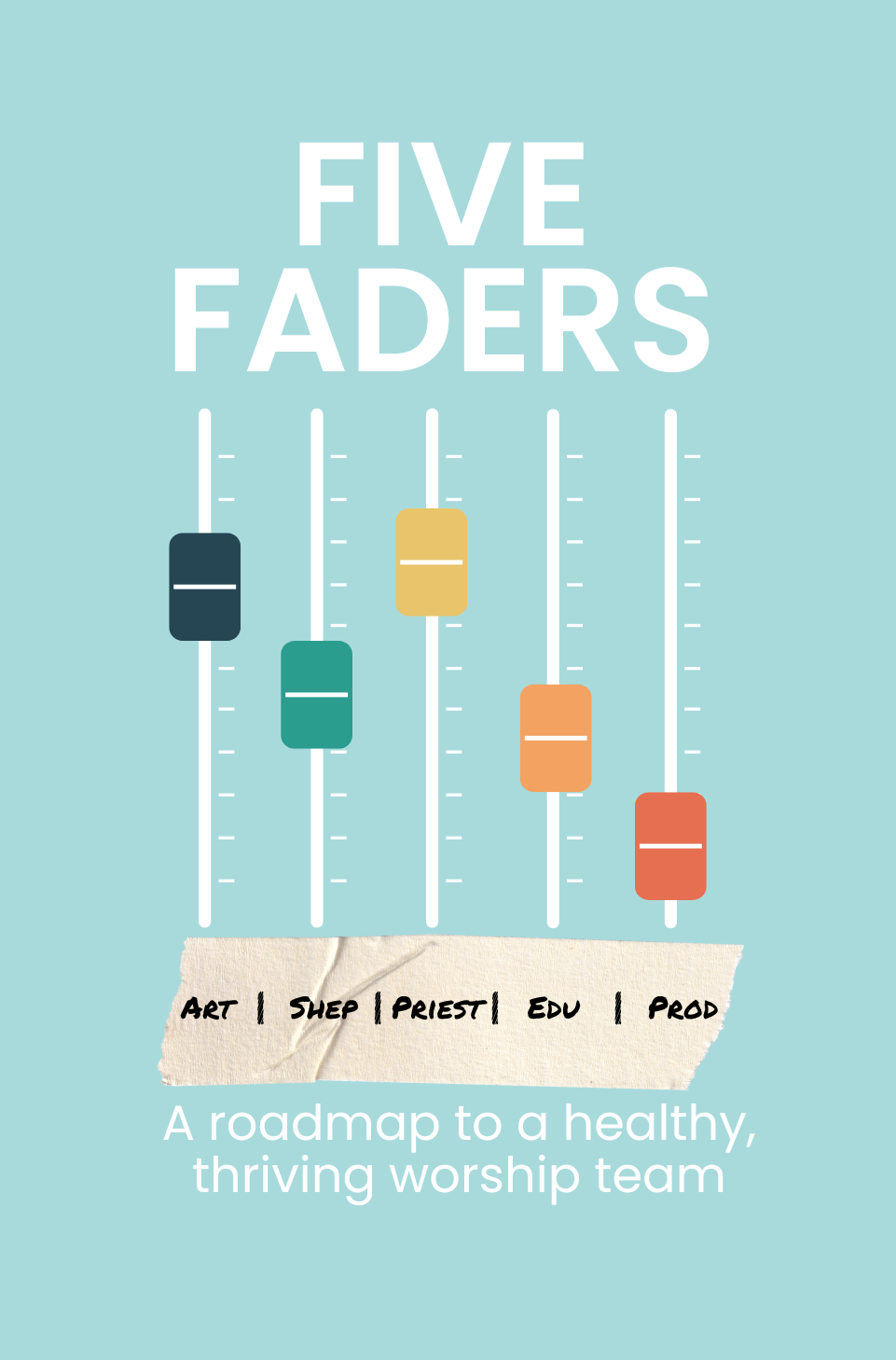
Why do some leaders succeed at building lasting worship ministries while others fail? In the Five Faders, Dave Helmuth explores the process of development and breaks down the lies, myths, and traps keeping you from being the fruitful leader God desires. Using decades of evidence-based insights, Dave reveals how understanding what motivates you is the first step in becoming a Five Faders Leader.
With our framework for becoming the best Artist, Shepherd, Priest, Educator, and Producer, you'll learn to slide each Fader up or down as Love requires you in each moment of leadership. Through relatable stories, insight gained from years of coaching worship teams in every kind of setting, and step-by-step advice, readers learn how to become the healthy expression of their Fader, build a culture of honor on your team to bring out the best in everyone, and be the most effective leader in the ever-changing landscape of ministry. Whether you’re looking to relieve frustration, increase confidence, or outlast change, this book offers the tools to become a Five Faders Leader.
Buy on Amazon at https://amzn.to/3WqUeKi.
DISCOUNTS: If you want to receive 10% off your order of 10 or more, order from this link and enter BULK10 to your order!

• Ceramic
• 11 oz mug dimensions: 3.79″ (9.6 cm) in height, 3.25″ (8.3 cm) in diameter
• 15 oz mug dimensions: 4.69″ (11.9 cm) in height, 3.35″ (8.5 cm) in diameter
• Lead and BPA-free material
• Colored rim, inside, and handle
• Dishwasher and microwave safe
Whether to fill it with Costa Rican coffee is up to you.