
How Do You “Strum” On The Piano

Most weekdays at 4 PMish, I give one of my kids a music lesson.
As you may imagine, they are not typical lessons. I either start playing an instrument to spark their curiosity, or I ask what song they are working on or what skill they’d like to strengthen.
Two of my daughters are learning piano. (the other is learning drums…she’ll be two in January) While they’re working independently on cool pop or classical songs like A Thousand Miles or Für Elise, I’m teaching them to play piano for worship.
Clementine asked me the other day, “Dad, how do you…strum on the piano.” That’s a phrase she read in the Five Faders book because I asked the very same question back in the early nineties.
She’s basically asking, “How do you decide how you play the chords on the chart in order to make music for that song?”
Great question! Because it assumes that the information given to you on a chord chart tells you very little about how to play that song.
I responded that it depends. Who else is playing with you? How skilled are they? What are you required to carry as the pianist? What are you able to play? I will play something completely different if I’m playing solo, or with a young team, or in a band of eight talented musicians. So let’s break down the options.
I’ve broken it into five categories: replication, rhythms, arpeggios, iconic melodic riffs, and voicings. Let me unpack each.
For each one, I typically play octaves and a fifth in my left hand. What changes is what my right hand is doing.
Replication
Replicating what you hear on a recording is essential. It puts other players’ ideas and go-tos into your hands. This will significantly improve your skill. It’s hard, but worth it. It’s a great place to start because someone else (who has lots of experience) has already thought about, experimented, thrown ideas away and started from scratch, rehearsed exhaustively, and finally recorded. And we get to learn from it. (or snub our noses and proclaim we are artists who want to make it our own.) Don’t be that guy. Learn to replicate.
Rhythms
You can play block chords on quarter notes, eighth notes, or whole/half notes. It’s amazing the dynamic range you can create simply by moving from quarter notes in one section to eighth notes in the next and ending on a whole note at the end of a chorus. Simple. Of course, you can spice it up by playing other rhythms and syncopations.
Arpeggios
One of my favorite musical devices is to play an arpeggio, a repeating pattern on the same notes, while changing the left hand. It produces color chords and the arpeggio works as a pedal. Build My Life, for example, has a recurring arpeggio for the first part of the song until the chorus.
This works especially well with what I call the magic chord. “Why? Because in many songs, you can play the same three notes in the right hand while changing the left hand. It just works…magically!
So it’s always the fifth, root, and fifth in the right hand. In G, you’d play a D, G, D in the right hand, and then play whatever the chords are in the left hand using octaves. So try it - play the magic chord in the right hand (D, G, D) and play octave Gs, followed by octave Es, octave Ds, octave Cs, and end on octave Gs in the left hand. Magic!” (This is a quote from https://www.adlibmusic.com/worship-fertilizer/455 where you can read more ideas on chords)
Iconic Melodic Riffs
This can be something that is well known from a recording of the song, whether or not typically done on piano, for example:
From The Inside Out (opening riff) - do this: play only the riff on the piano a couple times, then add the left hand and feel the chills!
Cornerstone (intro)
What a Beautiful Name (interlude to the bridge)
Forever Reign (intro)
Mighty to Save (intro, again on electric, but can be played on piano)
Why these are all Hillsong’s tunes, I don’t know, but you get the idea.
Holy Forever (intro)
I Speak Jesus (intro)
When you play them, it’s a subconscious signal to the congregation of where you’re going.
Voicings
When you first start playing piano, you learn chords in their “root position.” So a C chord is played C - E - G. But that same chord can be played E - G - C (called “first inversion”) or G - C - E (called “second inversion”). They sound different and there are advantages to playing with inversions. You can also add “color” to the chord by adding extra notes. You can play the chords near middle C, or an octave or two above or below it. It sounds and feels different.
You can also “bend the rules” (this is my favorite part). Sure, a chord is a triad made up of three notes. But what if you only “imply” the note? You can play a chord without the root, third, or fifth. You can play only the second note of the chord (the 2) and the fifth, with the rest being represented in the left hand with octaves and the fifth. So playing a C chord this way would be: left hand C - G - C and right hand D - G. Or get wild and play: left hand C - G - D and right hand E - G.
Can you see that you have SO MANY CHOICES, which is what makes it fun, but can be overwhelming. I encourage you to experiment.
-Dave Helmuth
Author of the Five Faders and Founder of Ad Lib Music
How Do You “Strum” On The Piano (Nº 487)

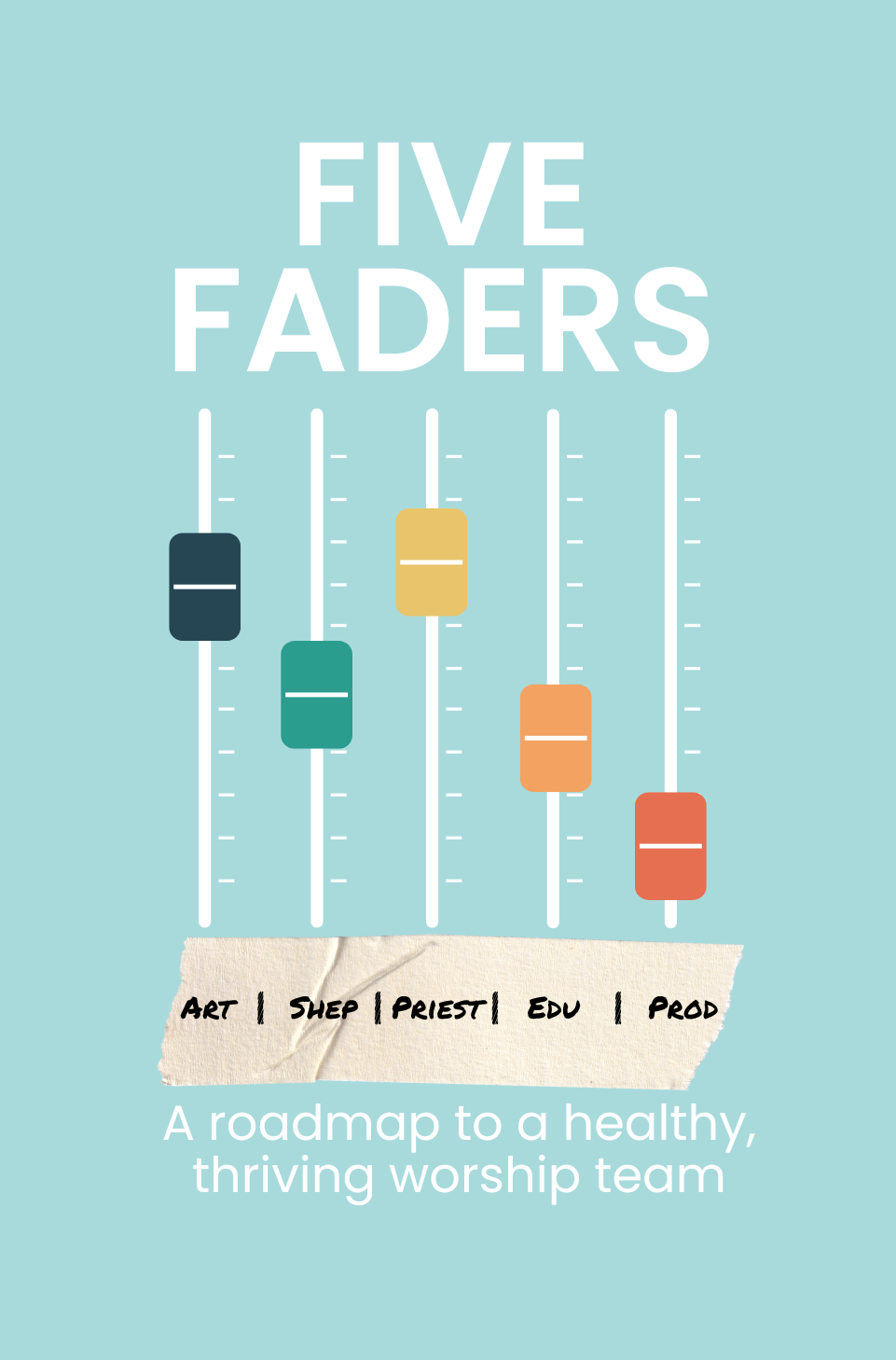
Why do some leaders succeed at building lasting worship ministries while others fail? In the Five Faders, Dave Helmuth explores the process of development and breaks down the lies, myths, and traps keeping you from being the fruitful leader God desires. Using decades of evidence-based insights, Dave reveals how understanding what motivates you is the first step in becoming a Five Faders Leader.
With our framework for becoming the best Artist, Shepherd, Priest, Educator, and Producer, you'll learn to slide each Fader up or down as Love requires you in each moment of leadership. Through relatable stories, insight gained from years of coaching worship teams in every kind of setting, and step-by-step advice, readers learn how to become the healthy expression of their Fader, build a culture of honor on your team to bring out the best in everyone, and be the most effective leader in the ever-changing landscape of ministry. Whether you’re looking to relieve frustration, increase confidence, or outlast change, this book offers the tools to become a Five Faders Leader.
Buy on Amazon at https://amzn.to/3WqUeKi.
DISCOUNTS: If you want to receive 10% off your order of 10 or more, order from this link and enter BULK10 to your order!

• Ceramic
• 11 oz mug dimensions: 3.79″ (9.6 cm) in height, 3.25″ (8.3 cm) in diameter
• 15 oz mug dimensions: 4.69″ (11.9 cm) in height, 3.35″ (8.5 cm) in diameter
• Lead and BPA-free material
• Colored rim, inside, and handle
• Dishwasher and microwave safe
Whether to fill it with Costa Rican coffee is up to you.